


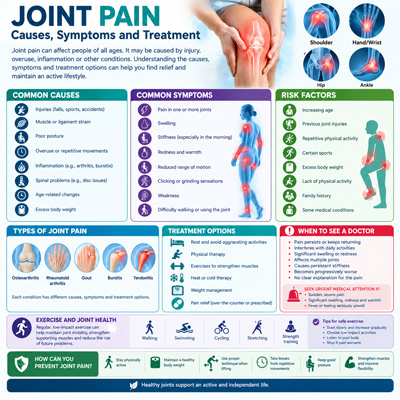
Joint Pain: Causes, Symptoms and Treatment
Introduction
Joint pain is a common problem that can affect people of all ages. It may occur in one joint or several joints and can range from mild discomfort to severe pain that interferes with everyday activities.
Joint pain can develop after an injury, excessive physical activity or repetitive movement. It can also be associated with inflammation, age-related changes or certain medical conditions.
This guide explains the common causes of joint pain, possible symptoms, risk factors, treatment options and when medical advice may be necessary.
What Is Joint Pain?
Joint pain refers to discomfort, soreness or pain in or around a joint.
It can affect:
- knees;
- hips;
- shoulders;
- elbows;
- wrists;
- fingers;
- ankles;
- other joints of the body.
Joint pain may be temporary or persistent. It can occur during movement, after physical activity or even while resting.
Common Causes of Joint Pain
There are many possible causes of joint pain.
Common causes include:
- injuries;
- muscle or ligament strain;
- overuse;
- inflammation;
- osteoarthritis;
- rheumatoid arthritis;
- gout;
- bursitis;
- tendon problems;
- infections affecting a joint.
The cause of joint pain can vary depending on the affected joint, the person’s age, activity level and other symptoms.
Joint Pain After an Injury
Joint pain may occur after:
- a fall;
- a sports injury;
- a twist or sudden movement;
- a direct blow;
- lifting or carrying heavy objects;
- repetitive physical activity.
An injury may affect the ligaments, tendons, muscles or structures inside the joint.
Swelling, bruising, stiffness or difficulty moving the joint may also occur.
Osteoarthritis
Osteoarthritis is a common joint condition associated with changes in the tissues within a joint.
It commonly affects:
- knees;
- hips;
- hands;
- spine.
Symptoms may include:
- joint pain;
- stiffness;
- reduced mobility;
- discomfort that may increase with activity;
- tenderness around the joint.
Symptoms can vary over time.
Rheumatoid Arthritis
Rheumatoid arthritis is an inflammatory autoimmune condition that can affect the joints.
It may cause:
- joint pain;
- swelling;
- stiffness;
- warmth around the joints;
- reduced mobility;
- fatigue.
Morning stiffness that lasts for a prolonged period can occur.
If several joints are persistently swollen or painful, medical assessment is important.
Gout
Gout is a type of inflammatory arthritis associated with elevated levels of uric acid and the formation of crystals in joints.
It can cause sudden episodes of:
- severe joint pain;
- swelling;
- redness;
- warmth;
- tenderness.
The big toe is a commonly affected joint, although gout can affect other joints as well.
Bursitis
Bursae are small fluid-filled sacs that help reduce friction around joints.
Inflammation of a bursa is known as bursitis.
It may cause:
- pain;
- swelling;
- tenderness;
- discomfort during movement.
Bursitis can occur after repetitive movements or prolonged pressure on a joint.
Joint Pain and Inflammation
Inflammation can contribute to joint pain and may cause:
- swelling;
- redness;
- warmth;
- stiffness;
- tenderness;
- reduced movement.
Inflammatory joint conditions may require medical treatment, particularly when symptoms persist or affect several joints.
Symptoms That May Accompany Joint Pain
Depending on the cause, joint pain may occur together with:
- swelling;
- stiffness;
- redness;
- warmth;
- tenderness;
- reduced range of motion;
- clicking or grinding sensations;
- weakness;
- difficulty walking or using the affected limb.
The pattern of symptoms can help a healthcare professional identify the possible cause.
Who May Be at Higher Risk?
The risk of joint problems may be increased by factors such as:
- increasing age;
- previous joint injuries;
- repetitive physical activity;
- certain sports;
- excess body weight;
- lack of physical activity;
- family history of certain joint conditions;
- certain medical conditions.
Having a risk factor does not necessarily mean that joint pain will develop.
How Is Joint Pain Diagnosed?
A healthcare professional may evaluate:
- the location of the pain;
- when symptoms started;
- how long they last;
- whether the pain is constant or intermittent;
- previous injuries;
- physical activity;
- swelling or redness;
- other symptoms;
- medical history.
A physical examination may also be performed.
Depending on the situation, additional tests may include blood tests or imaging such as X-rays, ultrasound or MRI.
Treatment for Joint Pain
Treatment depends on the underlying cause.
Possible approaches include:
- temporarily reducing activities that worsen symptoms;
- maintaining appropriate movement;
- physical therapy;
- exercises to strengthen surrounding muscles;
- weight management when appropriate;
- heat or cold applications;
- pain-relieving medicines when appropriate;
- prescription medicines for specific joint conditions.
If joint pain is caused by an underlying medical condition, treating that condition is an important part of management.
Exercise and Joint Health
Regular, appropriate physical activity can help maintain joint mobility and strengthen the muscles that support the joints.
Suitable activities may include:
- walking;
- swimming;
- cycling;
- gentle stretching;
- low-impact exercises;
- strength training adapted to individual needs.
Exercise should be increased gradually.
If a particular activity causes significant or persistent pain, it is advisable to stop and seek professional guidance.
How Can Joint Pain Be Prevented?
Some types of joint pain may be reduced by maintaining healthy habits.
Helpful measures include:
- staying physically active;
- maintaining a healthy body weight;
- warming up before exercise;
- using appropriate sports techniques;
- avoiding sudden increases in training intensity;
- taking breaks during repetitive activities;
- protecting previously injured joints;
- maintaining muscle strength and flexibility.
When Should You See a Doctor?
Medical advice is recommended if joint pain:
- persists or repeatedly returns;
- interferes with everyday activities;
- is associated with significant swelling;
- affects several joints;
- causes persistent stiffness;
- becomes progressively worse;
- develops without an obvious explanation;
- follows an injury and does not improve.
A healthcare professional can help determine the cause and recommend appropriate treatment.
When Is Joint Pain an Emergency?
Seek urgent medical attention if a joint becomes suddenly:
- extremely painful;
- significantly swollen;
- red and hot;
especially when these symptoms are accompanied by fever or feeling seriously unwell.
Urgent evaluation may also be necessary after a serious injury if there is severe pain, major swelling, obvious deformity or inability to use the affected limb.
Frequently Asked Questions
What is the most common cause of joint pain?
Joint pain can have many causes. Injuries, overuse and osteoarthritis are among the common causes.
Can weather cause joint pain?
Some people report that their joint symptoms change with weather conditions. However, the relationship between weather and joint pain varies from person to person.
Is exercise good for painful joints?
Appropriate, low-impact exercise can help maintain mobility and strengthen the muscles around joints. The type and intensity of exercise should be adapted to the individual’s condition.
Can excess weight contribute to joint pain?
Yes. Excess body weight can increase mechanical stress on weight-bearing joints such as the knees and hips.
What can I do at home for mild joint pain?
For mild symptoms, temporarily reducing activities that aggravate the pain, maintaining gentle movement and using heat or cold when appropriate may provide relief.
When should joint pain be checked by a doctor?
Persistent, recurrent or unexplained joint pain, particularly when accompanied by swelling, stiffness or reduced movement, should be medically assessed.
Key Takeaways
- Joint pain can have many causes, including injuries, overuse, inflammation and arthritis.
- Osteoarthritis commonly affects the knees, hips and hands.
- Rheumatoid arthritis can cause persistent inflammation, swelling and stiffness in several joints.
- Gout can cause sudden, severe attacks of painful, swollen and red joints.
- Regular, appropriate physical activity can help maintain joint mobility and muscle strength.
- Maintaining a healthy body weight may reduce stress on weight-bearing joints.
- Persistent or unexplained joint pain should be discussed with a healthcare professional.
- A suddenly very painful, swollen, red and hot joint, especially with fever, requires urgent medical evaluation.
Explore our Health & Wellness section on our website to learn more about joint health, pain management, mobility and everyday wellbeing.
https://pharmatoo.com/product-category/problems/joint-pain/
Tags
- joint pain
- joint pain causes
- joint pain symptoms
- joint pain treatment
- joint pain relief
- painful joints
- joint inflammation
- joint swelling
- joint stiffness
- arthritis
- osteoarthritis
- rheumatoid arthritis
- gout
- bursitis
- joint injury
- sports injury
- joint health
- healthy joints
- knee pain
- hip pain
- shoulder pain
- elbow pain
- wrist pain
- ankle pain
- finger joint pain
- joint mobility
- joint exercises
- low impact exercise
- joint pain prevention
- pain management
- muscle strength
- physical activity
- healthy weight
- musculoskeletal health
- mobility
- health and wellness
