


Aspirin vs Ibuprofen vs Paracetamol: What’s the Difference?
Introduction
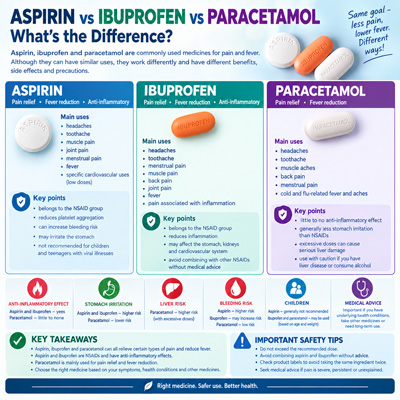
Aspirin, ibuprofen and paracetamol are commonly used medicines for pain and fever. Although they can have similar uses, they work differently and have different benefits, side effects and precautions.
Choosing the right medicine depends on the type of pain, your age, other health conditions and any medicines you already take.
This guide explains the main differences between aspirin, ibuprofen and paracetamol, when each may be used and what to consider before taking them.
Aspirin vs Ibuprofen vs Paracetamol at a Glance
| Medicine | Main uses | Anti-inflammatory effect | Reduces fever | Important consideration |
|---|---|---|---|---|
| Aspirin | Pain, fever, inflammation; specific cardiovascular uses at low doses | Yes | Yes | Can increase bleeding and irritate the stomach |
| Ibuprofen | Pain, fever, inflammation | Yes | Yes | Can affect the stomach, kidneys and cardiovascular system |
| Paracetamol | Pain and fever | Little to none | Yes | Excessive doses can seriously damage the liver |
The three medicines should not be considered interchangeable in every situation.
What Is Aspirin?
Aspirin is a salicylate medicine that belongs to the non-steroidal anti-inflammatory drug (NSAID) group.
It can be used to help relieve:
- headaches;
- toothache;
- muscle pain;
- joint pain;
- menstrual pain;
- fever;
- some inflammatory conditions.
At low doses, aspirin is also used for specific cardiovascular indications because it reduces platelet aggregation. This use is different from taking aspirin for pain relief and should generally be based on medical advice.
Important point
Aspirin can increase the risk of bleeding and may irritate the stomach.
It is generally not recommended for children and teenagers with viral illnesses because of the risk of Reye’s syndrome.
What Is Ibuprofen?
Ibuprofen is an NSAID that helps reduce pain, inflammation and fever.
It is commonly used for:
- headaches;
- toothache;
- menstrual pain;
- muscle pain;
- back pain;
- joint pain;
- fever;
- pain associated with inflammation.
Ibuprofen works by reducing the production of substances called prostaglandins, which are involved in pain and inflammation.
Because it has an anti-inflammatory effect, ibuprofen may be particularly useful when inflammation contributes to pain.
What Is Paracetamol?
Paracetamol, also known as acetaminophen, is widely used to relieve mild to moderate pain and reduce fever.
It may be used for:
- headaches;
- toothache;
- muscle aches;
- back pain;
- menstrual pain;
- cold and flu-related fever and aches.
Unlike aspirin and ibuprofen, paracetamol does not have significant anti-inflammatory activity at usual doses.
One of its advantages is that it generally does not have the same stomach-irritating effects as NSAIDs.
However, taking too much paracetamol can cause serious liver damage.
Aspirin vs Ibuprofen
Both aspirin and ibuprofen are NSAIDs, so they share some similarities.
Similarities
Both can:
- reduce pain;
- reduce fever;
- reduce inflammation.
Differences
Ibuprofen is commonly used for short-term treatment of pain and inflammation.
Aspirin has additional effects on platelets, meaning it can reduce blood clotting. This is why low-dose aspirin may be prescribed for certain cardiovascular conditions.
Aspirin and ibuprofen can both cause stomach irritation and increase the risk of gastrointestinal bleeding.
They should not be combined routinely without medical advice.
Ibuprofen vs Paracetamol
Ibuprofen and paracetamol are both commonly used for pain and fever, but they work differently.
Ibuprofen
Ibuprofen:
- reduces pain;
- reduces fever;
- reduces inflammation;
- belongs to the NSAID group.
Paracetamol
Paracetamol:
- reduces pain;
- reduces fever;
- has little anti-inflammatory effect;
- is not an NSAID.
For pain associated with inflammation, ibuprofen may provide an additional benefit. For many uncomplicated headaches or fever, paracetamol may be an appropriate option.
Aspirin vs Paracetamol
Aspirin and paracetamol can both relieve pain and reduce fever.
However, aspirin also has anti-inflammatory and antiplatelet effects.
Aspirin may be associated with:
- greater stomach irritation;
- increased bleeding tendency;
- interactions with anticoagulant medicines.
Paracetamol is generally associated with:
- less stomach irritation;
- little anti-inflammatory activity;
- a significant risk of liver damage when taken in excessive amounts.
Which Is Better for Headaches?
All three medicines may be used for certain types of headache.
The best option depends on the individual and the cause of the headache.
For occasional uncomplicated headaches, paracetamol or ibuprofen may be considered according to the product instructions.
If headaches are frequent, unusually severe or different from your usual headaches, the underlying cause should be evaluated rather than repeatedly treating the symptoms.
Which Is Better for Toothache?
Both ibuprofen and paracetamol can help relieve toothache.
Because dental pain may involve inflammation, an NSAID such as ibuprofen can sometimes be particularly useful.
Painkillers only provide temporary relief. Persistent toothache should be assessed by a dentist because the underlying dental problem may require treatment.
Which Is Better for Fever?
Paracetamol and ibuprofen can both reduce fever.
The appropriate choice depends on factors such as:
- age;
- other medical conditions;
- other medicines being taken;
- hydration status;
- whether inflammation is also present.
Always follow the dosing instructions for the specific product.
Which Is Better for Inflammation?
Ibuprofen and aspirin have anti-inflammatory effects, whereas paracetamol has little anti-inflammatory activity.
For conditions where inflammation is an important part of the pain, an NSAID may therefore be more appropriate.
However, NSAIDs are not suitable for everyone.
Which Is Gentler on the Stomach?
Paracetamol generally causes less stomach irritation than aspirin or ibuprofen when taken at recommended doses.
Aspirin and ibuprofen can irritate the stomach lining and, in some people, contribute to ulcers or gastrointestinal bleeding.
The risk may be higher in people who:
- have previously had stomach ulcers;
- take blood-thinning medicines;
- use NSAIDs frequently;
- are older;
- consume significant amounts of alcohol;
- have certain medical conditions.
Which Is Safer for the Liver?
Paracetamol is generally well tolerated when taken correctly, but excessive doses can cause severe liver injury.
The risk can be increased by:
- taking more than the recommended dose;
- taking several medicines containing paracetamol at the same time;
- heavy alcohol consumption;
- certain liver conditions.
Always check the ingredients of combination cold and flu medicines to make sure you are not accidentally taking paracetamol from multiple products.
Aspirin, Ibuprofen and Blood Thinners
Aspirin can reduce platelet aggregation and therefore increase bleeding risk.
Ibuprofen and other NSAIDs can also increase bleeding risk and may interact with certain medicines.
If you take:
- anticoagulants;
- antiplatelet medicines;
- regular aspirin;
- medicines for cardiovascular conditions;
you should check with a healthcare professional before using additional painkillers.
Can You Take Aspirin and Ibuprofen Together?
Taking aspirin and ibuprofen together is generally not something to do routinely without professional advice.
Both are NSAIDs and can increase the risk of side effects such as:
- stomach irritation;
- ulcers;
- gastrointestinal bleeding;
- kidney problems.
Ibuprofen may also interfere with the antiplatelet effect of low-dose aspirin when taken in certain circumstances.
If you regularly take low-dose aspirin, ask a healthcare professional or pharmacist which painkiller is most appropriate.
Can You Take Ibuprofen and Paracetamol Together?
Ibuprofen and paracetamol work differently and may sometimes be used together or alternated in certain circumstances.
However, combining medicines increases the risk of dosing mistakes.
If using more than one painkiller, carefully follow the instructions for each product and avoid exceeding the recommended daily dose.
For children, dosing should be based on the child’s age and/or weight and the specific product instructions.
Important Safety Considerations
Before taking aspirin or ibuprofen, speak with a healthcare professional if you have:
- a history of stomach ulcers;
- gastrointestinal bleeding;
- kidney disease;
- certain heart conditions;
- uncontrolled high blood pressure;
- asthma triggered by NSAIDs;
- problems with blood clotting;
- an allergy to NSAIDs.
Paracetamol also requires caution in people with liver disease or those who regularly consume large amounts of alcohol.
Aspirin, Ibuprofen and Paracetamol During Pregnancy
Medication use during pregnancy should be discussed with a healthcare professional.
In particular, NSAIDs such as aspirin and ibuprofen are not appropriate during certain stages of pregnancy, and aspirin has specific medical uses that should not be confused with routine pain relief.
Do not start regular painkiller treatment during pregnancy without appropriate medical advice.
What About Children?
Not all painkillers are suitable for children.
Aspirin should generally not be given to children or teenagers with viral infections because of the association with Reye’s syndrome.
Paracetamol and ibuprofen have pediatric formulations, but the correct dose depends on the child’s age, weight and the specific product.
Always follow the package instructions or advice from a healthcare professional.
How to Choose Between Them?
A simple way to think about the differences is:
Choose based on the type of symptoms
Pain + fever:
Paracetamol or ibuprofen may be appropriate for many people.
Pain + inflammation:
Ibuprofen may be useful because it has anti-inflammatory activity.
Specific cardiovascular indications:
Low-dose aspirin may be prescribed for certain people, but this is a medical use and is not the same as taking aspirin for ordinary pain.
Sensitive stomach or NSAID concerns:
Paracetamol may be considered when appropriate, provided there are no contraindications.
Common Mistakes to Avoid
Avoid:
- taking more than the recommended dose;
- using several products containing the same active ingredient;
- combining NSAIDs without professional advice;
- taking aspirin for a child with a viral illness;
- using painkillers for prolonged periods without addressing persistent symptoms;
- assuming that a higher dose will provide proportionally better pain relief.
Always read the active ingredients and dosing instructions on the package.
When Should You See a Doctor?
Seek medical advice if pain:
- is severe or unexplained;
- continues despite appropriate treatment;
- repeatedly returns;
- becomes progressively worse;
- is associated with unusual symptoms;
- follows a significant injury;
- requires frequent use of painkillers.
For headaches, urgent medical attention is particularly important when a severe headache appears suddenly or is accompanied by neurological symptoms, confusion, fainting, seizures or other serious symptoms.
Frequently Asked Questions
Is ibuprofen stronger than paracetamol?
Neither is universally “stronger.” They work differently, and ibuprofen may have an advantage when inflammation is contributing to pain.
Is aspirin the same as ibuprofen?
No. Both are NSAIDs, but they are different medicines and have different properties and uses.
Does paracetamol reduce inflammation?
Paracetamol has little anti-inflammatory activity compared with NSAIDs such as ibuprofen and aspirin.
Which is better for a fever?
Both paracetamol and ibuprofen can reduce fever. The best choice depends on the person’s age, health conditions and other medicines.
Which is easier on the stomach?
Paracetamol generally has less effect on the stomach than aspirin or ibuprofen.
Can I take aspirin for a headache?
Aspirin can relieve some types of headache in appropriate adults, but it is not suitable for everyone and can increase bleeding and stomach-related risks.
Can I take painkillers every day?
Regular or prolonged use of painkillers should be discussed with a healthcare professional. Frequent use can cause side effects and, with some headache medicines, can contribute to medication-overuse headaches.
Key Takeaways
- Aspirin, ibuprofen and paracetamol can all relieve certain types of pain and reduce fever, but they work differently.
- Aspirin and ibuprofen are NSAIDs and have anti-inflammatory effects.
- Paracetamol is mainly used for pain relief and fever reduction and has little anti-inflammatory activity.
- Ibuprofen may be particularly useful when inflammation contributes to pain.
- Aspirin can increase bleeding risk and has specific cardiovascular uses under medical guidance.
- Excessive paracetamol can cause serious liver damage.
- Aspirin and ibuprofen can irritate the stomach and may increase the risk of gastrointestinal bleeding.
- Do not routinely combine aspirin and ibuprofen without professional advice.
- Always check the active ingredients of combination medicines to avoid accidentally exceeding recommended doses.
- Persistent, severe or unexplained pain should be medically evaluated.
Explore our Pain Relief & Medicines section on our website to learn more about headaches, fever, inflammation, pain management and commonly used medicines.
https://pharmatoo.com/product-category/pharmacy/painkillers/
Tags
- aspirin vs ibuprofen
- aspirin vs paracetamol
- ibuprofen vs paracetamol
- aspirin ibuprofen paracetamol
- painkillers comparison
- pain relief
- pain relief medicines
- headache treatment
- fever treatment
- inflammation
- anti-inflammatory medicines
- NSAIDs
- aspirin
- ibuprofen
- paracetamol
- acetaminophen
- aspirin benefits
- ibuprofen benefits
- paracetamol benefits
- aspirin side effects
- ibuprofen side effects
- paracetamol side effects
- stomach painkillers
- liver safety
- medication safety
- over the counter medicines
- OTC painkillers
- headache medicine
- toothache medicine
- muscle pain
- joint pain
- back pain
- fever reducer
- anti-inflammatory
- pain management
- safe pain relief
- medicines for adults
- children’s pain relief
- health and wellness
