



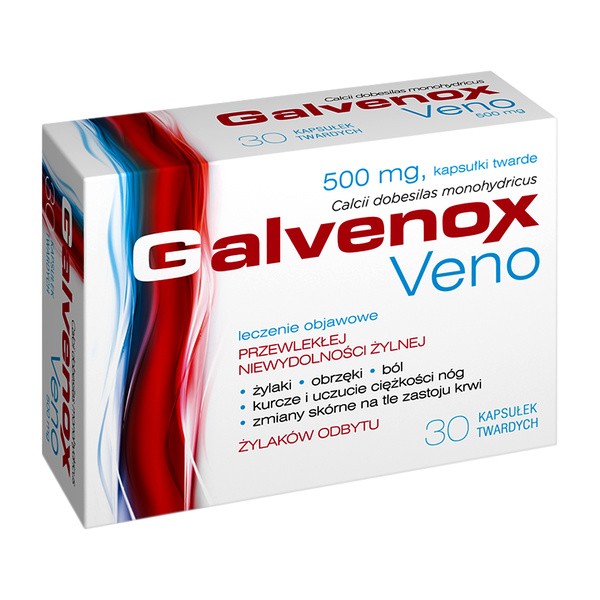
Description
Galvenox Veno hard capsules are a drug used for problems such as painful leg cramps, varicose veins or leg swelling – when the conditions result from blood stasis in the veins. Galvenox Veno improves blood flow in the veins and strengthens blood vessels. The drug also applies to hemorrhoid problems.
Composition
The active substance is calcium dobesylate.
One hard capsule contains 500 mg of calcium dobenolate.
Excipients: microcrystalline cellulose, magnesium stearate, titanium dioxide (E 171), azorubin (E 122), quinoline yellow (E 104), gelatin.
Dosage
Galvenox Veno should always be dosed exactly as described in the package leaflet or as directed by your doctor or pharmacist. If you are not sure, talk to your doctor or pharmacist.
The drug is taken orally, preferably during the main meals. The recommended dosage of Galvenox Veno in adults is 1 to 2 capsules per day. The treatment period is from a few weeks to several months.
Action
Galvenox Veno (calcium dovesylate) has a positive effect on blood vessels and lymphatic vessels. It increases their flexibility and strength, reduces their permeability and brittleness. It also improves the elasticity of red blood cells and has a partial anti-aggregation effect. These actions translate into better blood flow through the vessels and a reduction in its stasis.
Indications
Galvenox Veno is taken in case of problems with the venous vessels of the legs or anus (the so-called hemorrhoids). Problems with venous circulation in the legs can manifest themselves through: pain, cramps, feeling of heaviness of the legs, tingling, numbness of the lower limbs, skin changes associated with venous stasis, varicose veins of the lower extremities, swelling associated with chronic venous insufficiency.
Contraindications
Galvenox Veno should not be taken by people who are hypersensitive to calcium dosetile or excipients of the drug.
Side effects
Like all medicines, Galvenox Veno can cause side effects, although not everybody gets them.
There have been allergic reactions to the drug, which have manifested themselves with a rash or hives.
Rarely (less than 1 in 1,000 people, but more than 1 in 10,000) Galvenox Veno may cause side effects such as hyperabdominal pain, nausea, diarrhoea, vomiting, skin reactions, joint pain, pain and dizziness, fever.
Very rare (less than 1 in 10 000 people) has been infected with agranulocytosis (an acute condition that can be manifested by high fever, infections in the mouth or inflammation in the anus and genitals). In such cases, you should stop using the medicine and contact your doctor.
Warnings and precautions
If you have a digestive system disease (active gastric or duodenal ulcer disease or chronic gastritis) tell your doctor.
If you experience symptoms such as fever, sore throat or larynx, pain during swallowing, rhinitis, inflammation of the mouth, inflammation of the genitals and anus, then you should stop the medicine and contact your doctor, as these may be symptoms of a severe disease – agranulocytosis.
In people with kidney failure, it may be necessary to reduce the dose of the drug.
The medicine contains azorubine (E 122) and may cause allergic reactions.
Store below 25oC and original packaging to protect against moisture.
Keep the medicine out of the reach of children.
Using the drug with food and drink
Galvenox Veno should be taken during the main meals.
Pregnancy and breastfeeding
If you are pregnant or breast-feeding, think you may be pregnant or if you are planning to have a baby, talk to your doctor or pharmacist before taking this medicine.
Pregnancy: Galvenox Veno can only be used in pregnant women if the potential benefit of the medicine outweighs the possible risk to the fetus. Galvenox Veno is contraindicated in the first trimester of pregnancy.
Breast-feeding: The drug is excreted in small amounts into the milk of breastfeeding women. There are no data on the effect of the medicine on the breast-fed infant. Before you start taking this medicine, you should stop breast-feeding.
Effects on laboratory tests
If you are pregnant or breast-feeding, think you may be pregnant or are planning to have a baby, talk to your doctor or pharmacist before taking this medicine.
Use of the drug in children and adolescents
The drug is not intended for use in children.


Reviews
There are no reviews yet.