


Instructions
Dosage and Administration
Orally.
Adults and children over 15 years of age, take 1 sachet 2-3 times daily.
Dissolve the contents of the sachet completely in a glass (200 ml) of warm water (50-60°C) and drink the resulting solution immediately.
It is best to take the medication between meals.
The maximum daily dose is 3 sachets.
The interval between doses should be at least 4 hours.
For patients with impaired liver or kidney function and in elderly patients, the interval between doses should be at least 8 hours.
The duration of AntiGrippin use without consulting a doctor should not exceed 5 days when prescribed as a pain reliever and 3 days when prescribed without consulting a doctor. As an antipyretic.
Indications
Infectious and inflammatory diseases (ARI, flu), accompanied by fever, chills, headache, joint and muscle pain, nasal congestion, sore throat and sinuses
Composition
Per sachet:
Active ingredients:
Paracetamol – 500.00 mg
Chlorphenamine maleate – 10.00 mg
Ascorbic acid – 200.00 mg
Excipients:
Chamomile:
Sodium bicarbonate 644.00 mg, citric acid 928.00 mg, sorbitol 317.00 mg, povidone 16.00 mg, sucrose 2058.00 mg, sodium cyclamate 42.00 mg, aspartame 20.00 mg, acesulfame potassium 15.00 mg, chamomile extract 250.00 mg.
Contraindications
-Hypersensitivity to paracetamol, ascorbic acid, chlorphenamine, or any other component of the drug.
-Erosive and ulcerative lesions of the gastrointestinal tract (in the acute phase).
-Severe renal and/or hepatic insufficiency.
-Alcoholism.
-Closed-angle Glaucoma.
-Phenylketonuria.
-Prostatic hyperplasia.
-Children (under 15 years).
-Pregnancy and lactation.
Caution: renal and/or hepatic insufficiency, deficiency. Glucose-6-phosphate dehydrogenase deficiency, congenital hyperbilirubinemia (Gilbert, Dubin-Johnson, and Rotor syndromes), viral hepatitis, alcoholic hepatitis, and old age.
Special instructions
When taking metoclopramide, domperidone, or cholestyramine, you should also consult a doctor.
With prolonged use in doses significantly exceeding the recommended ones, the likelihood of liver and kidney dysfunction increases; peripheral blood monitoring is necessary.
Paracetamol and ascorbic acid may distort laboratory test results (quantitative determination of glucose and uric acid in blood plasma, bilirubin, activity of “liver” transaminases, LDH).
To avoid toxic liver damage, paracetamol should not be combined with alcoholic beverages, and should not be taken by individuals prone to Chronic alcohol consumption. The risk of liver damage increases in patients with alcoholic hepatosis. Prescribing ascorbic acid to patients with rapidly proliferating and intensely metastatic tumors may worsen the process. In patients with elevated iron levels, ascorbic acid should be used in minimal doses.
One chamomile sachet contains 2.058 g of sugar, which corresponds to 0.17 XE.
Packaging and release form
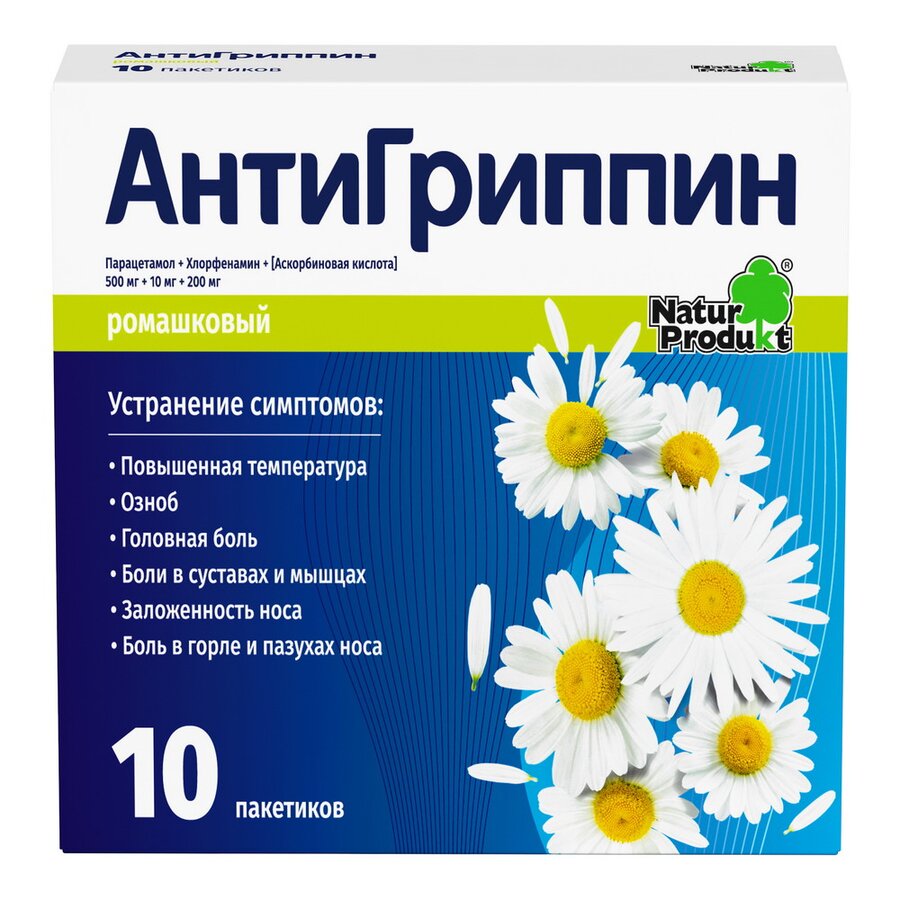
Powder for oral solution [chamomile], 500 mg + 10 mg + 200 mg, 5.0 g of powder in a sachet – 10 pcs per pack.
Side effects
The drug is well tolerated in recommended doses.
In isolated cases, the following may occur:
CNS: headache, fatigue;
Gastrointestinal: nausea, epigastric pain;
Endocrine: hypoglycemia (up to the development of coma);
from the hematopoietic organs: anemia, hemolytic anemia (especially for patients with glucose-6-phosphate dehydrogenase deficiency); Very rare – thrombocytopenia;
Allergic reactions: skin rash, itching, urticaria, angioedema, anaphylactoid reactions (including anaphylactic shock), erythema multiforme (including Stevens-Johnson syndrome), toxic epidermal necrolysis (Lyell’s syndrome);
Other: hypervitaminosis C, metabolic disorders, sensation of heat, dry mouth, accommodation paresis, urinary retention, drowsiness.
Report all side effects to your doctor.
Pharmacotherapeutic group
ARI and “colds” symptom relief agent (non-narcotic analgesic + h1-histamine receptor blocker + vitamin)
Interaction with other drugs
Ascorbic acid
- increases blood concentrations of benzylpenicillin and tetracycline


Reviews
There are no reviews yet.