


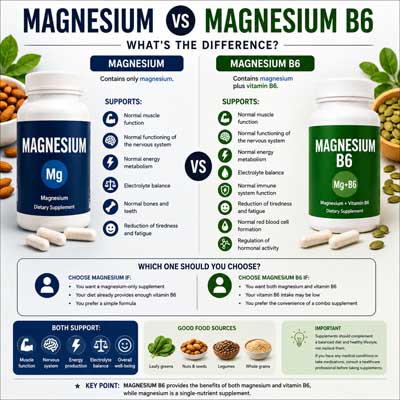
Magnesium vs Magnesium B6: What’s the Difference?
Introduction
Magnesium is an essential mineral that plays an important role in many functions of the body. It contributes to normal muscle function, normal nervous system function, normal energy metabolism and electrolyte balance.
Magnesium B6 combines magnesium with vitamin B6, providing two essential nutrients in one supplement.
But what is the difference between magnesium and Magnesium B6? Which option may be more suitable, and when can a combination supplement be useful?
This guide explains the main differences between magnesium and Magnesium B6.
What Is Magnesium?
Magnesium is an essential mineral involved in numerous processes throughout the body.
Magnesium contributes to:
- normal muscle function;
- normal functioning of the nervous system;
- normal energy-yielding metabolism;
- maintenance of electrolyte balance;
- normal protein synthesis;
- normal psychological function;
- maintenance of normal bones and teeth;
- reduction of tiredness and fatigue.
Magnesium can be obtained from foods such as nuts, seeds, legumes, whole grains and green leafy vegetables.
Magnesium supplements are available in different forms and dosages.
What Is Magnesium B6?
Magnesium B6 is a combination supplement containing magnesium and vitamin B6.
Vitamin B6 contributes to:
- normal functioning of the nervous system;
- normal psychological function;
- normal energy metabolism;
- reduction of tiredness and fatigue;
- normal red blood cell formation;
- normal immune system function;
- regulation of hormonal activity.
Therefore, Magnesium B6 provides the functions associated with both magnesium and vitamin B6.
Magnesium vs Magnesium B6: The Main Difference
The main difference is the composition.
| Feature | Magnesium | Magnesium B6 |
|---|---|---|
| Magnesium | ✓ | ✓ |
| Vitamin B6 | ✗ | ✓ |
| Supports normal muscle function | ✓ | ✓ |
| Supports normal nervous system function | ✓ | ✓ |
| Supports normal energy metabolism | ✓ | ✓ |
| Provides vitamin B6 | ✗ | ✓ |
| Combines two nutrients | ✗ | ✓ |
Magnesium B6 is not a different form of magnesium. It is a supplement that combines magnesium with vitamin B6.
What Does Magnesium Do?
Magnesium has several important roles in the body.
Supports Muscle Function
Magnesium contributes to normal muscle function and helps maintain normal muscular activity.
Supports the Nervous System
Magnesium contributes to normal functioning of the nervous system.
Supports Energy Metabolism
Magnesium contributes to normal energy-yielding metabolism and the reduction of tiredness and fatigue.
Supports Electrolyte Balance
Magnesium contributes to the maintenance of normal electrolyte balance.
What Does Vitamin B6 Do?
Vitamin B6 has its own important functions.
Supports the Nervous System
Vitamin B6 contributes to normal functioning of the nervous system.
Supports Energy Metabolism
Vitamin B6 contributes to normal energy-yielding metabolism.
Supports the Immune System
Vitamin B6 contributes to the normal function of the immune system.
Helps Reduce Tiredness and Fatigue
Vitamin B6 contributes to the reduction of tiredness and fatigue.
Why Combine Magnesium and Vitamin B6?
Combining magnesium and vitamin B6 allows a person to obtain both nutrients from one supplement.
This can be convenient for people who want to supplement magnesium while also obtaining vitamin B6.
However, a combination supplement is not automatically better for everyone.
The choice should depend on dietary intake, individual nutritional needs and the composition and dosage of the particular product.
Magnesium or Magnesium B6: Which Should You Choose?
There is no single option that is best for everyone.
Magnesium May Be Suitable When:
- you are specifically looking for a magnesium supplement;
- your diet already provides sufficient vitamin B6;
- you do not need additional vitamin B6;
- you prefer a supplement containing only magnesium.
Magnesium B6 May Be Suitable When:
- you want to supplement both magnesium and vitamin B6;
- your dietary intake of vitamin B6 may be insufficient;
- you prefer a combination product;
- the specific product provides appropriate amounts of both nutrients.
Always check the nutritional information and recommended daily dosage.
Magnesium B6 and the Nervous System
Both magnesium and vitamin B6 contribute to normal nervous system function.
This is one reason why magnesium and vitamin B6 are frequently combined in nutritional supplements.
However, supplements should not be considered a treatment for unexplained neurological symptoms.
Persistent symptoms such as numbness, weakness, tremors or significant changes in mood should be discussed with a healthcare professional.
Magnesium B6 and Fatigue
Both magnesium and vitamin B6 contribute to normal energy metabolism and the reduction of tiredness and fatigue.
If tiredness persists despite adequate nutrition and rest, it is important to consider other possible causes rather than assuming that magnesium or vitamin B6 deficiency is responsible.
Can You Get Magnesium and Vitamin B6 From Food?
Yes.
Magnesium can be found in:
- nuts;
- seeds;
- legumes;
- whole grains;
- green leafy vegetables;
- some fish and other foods.
Vitamin B6 is found in a variety of foods, including:
- poultry;
- fish;
- meat;
- potatoes;
- some fruits and vegetables;
- fortified foods.
A varied and balanced diet can provide both nutrients.
Is Magnesium B6 Better Than Magnesium Alone?
Not necessarily.
Magnesium B6 contains an additional nutrient, but this does not automatically make it better than magnesium alone.
If you only need magnesium, a magnesium-only supplement may be sufficient.
If you also want to supplement vitamin B6, a combination product may be more convenient.
The most important factors are the actual amounts of magnesium and vitamin B6 provided by the product and whether those amounts are appropriate for your needs.
What Should You Check Before Buying?
When comparing magnesium and Magnesium B6 supplements, look at:
- the amount of elemental magnesium per serving;
- the form of magnesium;
- the amount of vitamin B6;
- recommended daily dosage;
- additional ingredients;
- warnings and precautions.
Different magnesium products can contain different magnesium compounds, and the amount of elemental magnesium can vary considerably.
Can You Take Magnesium and Vitamin B6 Together?
Magnesium and vitamin B6 are commonly included together in combination supplements.
However, if you are already taking several supplements, check the labels to avoid unnecessarily duplicating magnesium or vitamin B6.
People taking medications or those with certain medical conditions should consult a healthcare professional before starting regular supplementation.
Frequently Asked Questions
Is Magnesium B6 the same as magnesium?
No. Magnesium B6 contains magnesium plus vitamin B6. Magnesium-only supplements contain magnesium without added vitamin B6.
Which is better: magnesium or Magnesium B6?
Neither is universally better. The appropriate choice depends on whether you also want or need vitamin B6.
What is Magnesium B6 used for?
Magnesium B6 provides both magnesium and vitamin B6, which contribute to normal nervous system function, energy metabolism and other normal body functions.
Can Magnesium B6 help with tiredness?
Both magnesium and vitamin B6 contribute to the reduction of tiredness and fatigue when consumed in adequate amounts as part of the diet.
Does Magnesium B6 contain more magnesium?
Not necessarily. The amount of magnesium depends on the individual product. Always check the label for the amount of elemental magnesium per serving.
Can I take magnesium without vitamin B6?
Yes. Magnesium is available as a standalone supplement, and vitamin B6 is not required in every magnesium product.
Can I take magnesium and vitamin B6 every day?
Daily supplementation may be appropriate depending on the product, dosage and individual nutritional needs. Follow the product instructions and recommended dosage.
Can Magnesium B6 replace a balanced diet?
No. Supplements should complement a varied and balanced diet rather than replace it.
Key Takeaways
- Magnesium is an essential mineral involved in muscle function, nervous system function, energy metabolism and electrolyte balance.
- Magnesium B6 combines magnesium with vitamin B6.
- Vitamin B6 contributes to normal nervous system function, energy metabolism and immune function.
- Magnesium and vitamin B6 both contribute to the reduction of tiredness and fatigue.
- Magnesium alone may be sufficient when additional vitamin B6 is not needed.
- Magnesium B6 may be convenient when both nutrients are desired in one supplement.
- Always compare the actual amounts of magnesium and vitamin B6 rather than choosing a product based only on its name.
- A balanced diet remains the foundation for obtaining essential nutrients.
- If you have persistent symptoms or take medications regularly, consult a healthcare professional before starting supplementation.
Explore our Vitamins & Supplements collection to find magnesium, vitamin B6 and other nutritional products for your daily needs.
https://pharmatoo.com/product-category/vitamins-and-minerals/
Tags
- magnesium vs magnesium B6
- magnesium B6
- magnesium supplements
- magnesium benefits
- vitamin B6
- vitamin B6 benefits
- magnesium deficiency
- magnesium and vitamin B6
- magnesium for muscles
- magnesium for nervous system
- magnesium and fatigue
- vitamin B6 and energy
- magnesium tablets
- magnesium nutrition
- magnesium and B6
- magnesium comparison
- magnesium supplement
- magnesium and vitamin B6 benefits
